
How to Become a CNA in Florida: Steps and Pay
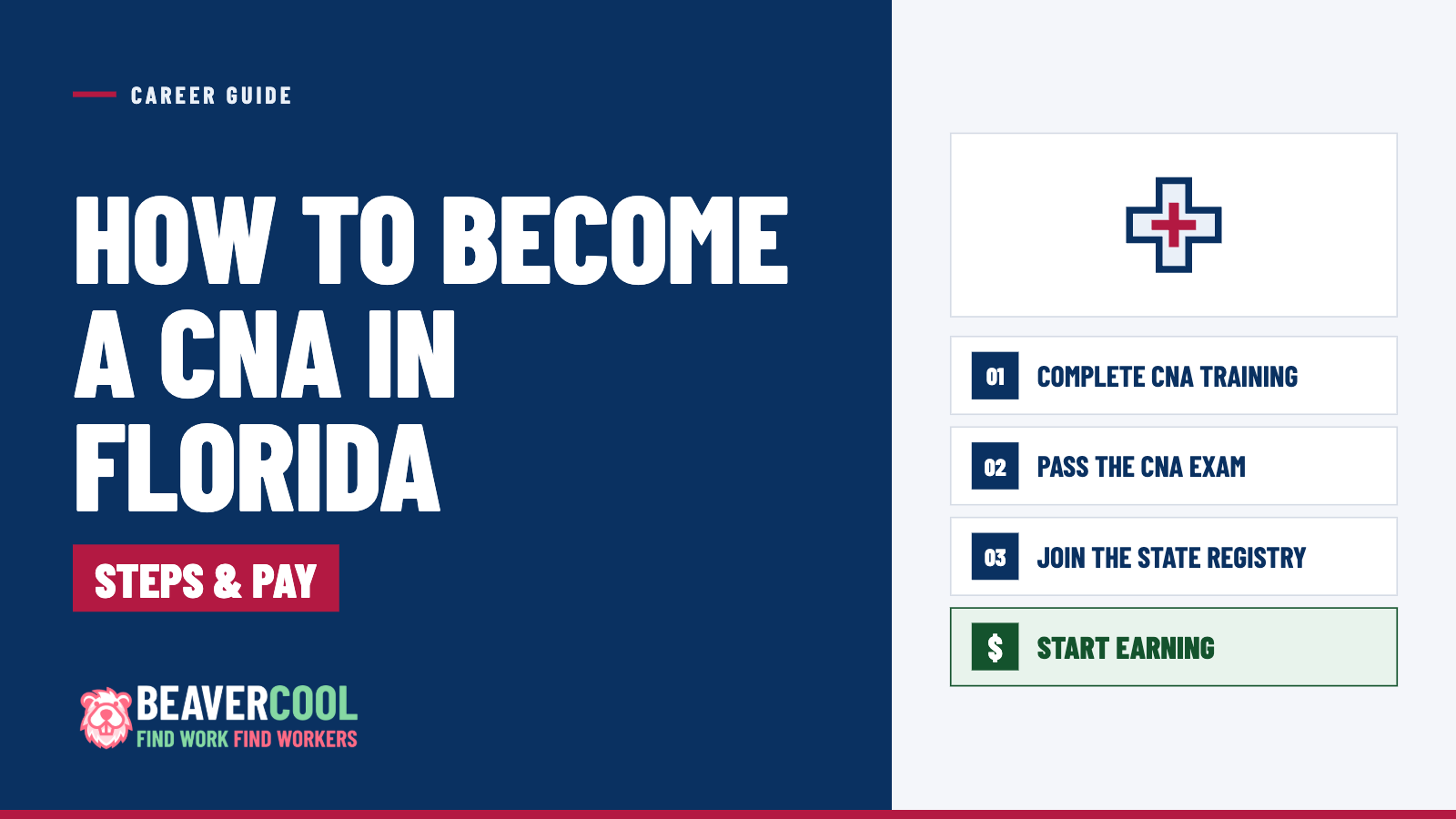
To figure out how to become a cna in florida, you must select one of three state eligibility routes, pass a Level II Livescan background check, and pass the state Prometric competency exam. Florida allows you to challenge the licensing test without taking classes if you are at least 18 years old or hold a high school diploma. If you graduate from a state-approved training program, you only need to pass the written exam as long as you test within six months of graduation.
Certified nursing assistants provide essential direct care in hospitals, nursing homes, assisted living facilities, and private homes. They assist patients with bathing, dressing, eating, mobility, and checking vital signs. Demand remains high across the state, creating steady Florida healthcare jobs for candidates who meet state standards.
Quick Overview: Steps to Become a CNA in Florida
Getting your certified nursing assistant license in Florida follows a clear legal process managed by the state. You can complete the process in a few weeks or several months, depending on your training route.
Follow these core steps to earn your certification:
- Choose your eligibility pathway: Decide whether to attend an approved training school or challenge the state examination directly.
- Submit your application: Apply for your license examination through Prometric, the state testing vendor for the Florida Board of Nursing.
- Complete Level II fingerprinting: Schedule electronic Livescan fingerprinting using the mandatory state agency code.
- Pass the state exam: Take and pass the written knowledge test and the clinical skills demonstration (unless exempt from skills testing).
- Receive your license: The Florida Board of Nursing issues your CNA license number once testing files and background checks clear.
Florida CNA Eligibility Routes: Training vs. Exam Challenge
The Florida Board of Nursing recognizes three distinct eligibility pathways for initial CNA licensure by examination. Every route requires candidates to complete the same Level II background check before receiving a license.
First, you can complete a state-approved nursing assistant training course and pass the state competency exam. Second, you can qualify if you have a high school diploma or equivalent (such as a GED) and pass the exam. Third, you can qualify if you are at least 18 years old and pass the exam, even without a high school diploma or prior healthcare schooling. This flexibility makes CNA certification one of the most accessible entry-level jobs with no experience required upfront.
Who Qualifies to Challenge the Florida CNA Exam?
Florida is one of the few states that allows candidates to challenge the CNA exam without attending school. If you meet the age requirement (18 or older) or hold a high school credential, you can apply directly to Prometric to take the test. Many people who work as home health aides or personal care assistants use this option to get certified quickly.
However, challenging the test carries real risks. If you challenge the test without formal instruction, you must take both the written exam and the hands-on clinical skills exam. Florida enforces a strict retest rule: if you fail the nursing assistant competency exam three times, you lose eligibility to retest until you complete an approved training program. Studying state clinical skill checklists thoroughly before challenging the exam helps protect your testing attempts.
The 6-Month Training Exemption Rule
Attending a formal training program offers a major testing advantage under Florida law. Candidates who complete an approved training program within six months of applying only have to take and pass the written portion of the Prometric examination.
Graduating from an approved school waives the stressful clinical skills demonstration test if you file your application promptly. If you wait longer than six months after completing your program to apply, you lose this waiver and must take both the written test and the clinical skills evaluation.
Florida CNA Background Screening and Disqualifications
Florida law requires strict criminal screening for all direct-care medical workers. Under Florida House Bill 975, CNA candidates must undergo Level II electronic background screening through the Florida Department of Law Enforcement (FDLE) and the Federal Bureau of Investigation (FBI).
Applicants must pay all costs for their background screening and testing fees directly. You must register with an approved Livescan vendor before testing.
Livescan ORI Code and AHCA Clearinghouse Photo
When scheduling your electronic fingerprint appointment, you must provide ORI code EDOH0380Z. This code directs your background check results directly to the Florida Board of Nursing.
During your Livescan appointment, the technician must take your digital photograph. Florida law requires this photo so your profile enters the Agency for Health Care Administration (AHCA) Care Provider Background Screening Clearinghouse. If you do not have your photograph taken during your fingerprint session, state agencies cannot share your screening results. This error delays your application and forces you to repeat the screening at your own expense.
Disqualifying Felonies and Statutory Waiting Periods
Florida Statute Section 456.0635 bars individuals with certain felony convictions from obtaining a healthcare license. Licensure is automatically denied for felony convictions under Florida Chapters 409 (social and economic assistance fraud), 817 (fraudulent practices), or 893 (drug abuse prevention and control) unless specific waiting periods have passed:
- First-degree and second-degree felonies: You must wait more than 15 years after completing your sentence and probation.
- Third-degree felonies: You must wait more than 10 years after completing your sentence and probation.
- Third-degree drug possession felonies: Offenses under Section 893.13(6)(a) require a waiting period of more than 5 years after completing your sentence.
If you have a disqualifying criminal offense on record for an AHCA-regulated care setting, you cannot seek an exemption until at least two years have passed since you satisfied all non-monetary obligations and paid all court fines and fees in full.
The Florida CNA Prometric Examination
Prometric manages CNA application intake and administers the state exam for the Florida Department of Health. You submit your application packet directly to Prometric.
The examination has two distinct components:
- Written Knowledge Test: A multiple-choice exam covering infection control, resident safety, communication, patient rights, and basic nursing duties.
- Clinical Skills Test: A practical demonstration where an evaluator watches you perform five randomly assigned patient-care skills on a volunteer or mannequin (such as hand hygiene, measuring vital signs, or moving a resident).
Prepare thoroughly for both sections to avoid the three-attempt limit. Once Prometric receives your test scores and your background screening clears, they forward the file to the state. The Florida Board of Nursing reviews CNA applications within 30 days of receiving the file from Prometric and notifies you if your file has any missing items.
Finding State-Approved CNA Classes in Florida
If you choose the training path, make sure your school holds approval from the state. The Florida Board of Nursing approves pre-licensure nursing education programs under Section 464.019, Florida Statutes. You can review active listings directly on the Florida Board of Nursing website.
Approved programs are offered through community colleges, technical centers, high schools, and private vocational institutes. Under Florida law, the Board approves programs based on statutory curriculum standards, though the Board is not authorized to conduct physical site visits to training facilities. Always research school completion rates, pass rates, and student feedback before enrolling.
Many nursing homes and healthcare networks sponsor training classes. In these programs, the facility covers the training tuition in exchange for a commitment to work for them as a CNA after you earn your license.
CNA Salary and Career Outlook in Florida
CNA pay in Florida varies depending on the care setting, facility location, and shifts worked. While Florida state-level wage figures vary by local market, federal data provides an accurate benchmark for healthcare earnings.
According to the U.S. Bureau of Labor Statistics (BLS) May 2025 data, the national median annual wage for nursing assistants was $42,260. The lowest 10 percent earned less than $33,940, while the highest 10 percent earned over $51,980. Combined data for nursing assistants and orderlies showed a median hourly wage of $20.13, making CNA work one of several solid jobs that pay $20 an hour without a degree.
National median annual wages vary across major healthcare sectors:
- Government healthcare facilities: $47,050
- Skilled nursing facilities: $43,000
- Hospitals (state, local, and private): $42,310
- Assisted living and retirement communities: $39,490
- Home healthcare services: $38,040
Hospitals and skilled nursing facilities employ the vast majority of aides. In 2025, nursing assistants held roughly 1.5 million jobs across the country, with 36 percent working in nursing care facilities and 32 percent working in hospitals.
Job security remains strong. The BLS projects employment for nursing assistants and orderlies to grow 3 percent from 2025 to 2035, with approximately 203,300 job openings expected each year nationwide due to retirements and career transitions. In Florida, large retiree populations drive steady hiring for CNA jobs in Orlando and healthcare positions in Tampa.
Working as a CNA also provides clinical experience if you plan to advance into higher-paying medical roles, such as a Licensed Practical Nurse (LPN) or Registered Nurse (RN).
Find CNA Jobs in Florida
Once you pass your exam and clear your background screening, you can begin working in Florida's healthcare facilities immediately. Start browsing local clinic, hospital, and nursing home openings on BeaverCool's Florida healthcare jobs board to find open shifts near you.