
How to Get a CDL in New Jersey: Step-by-Step Guide
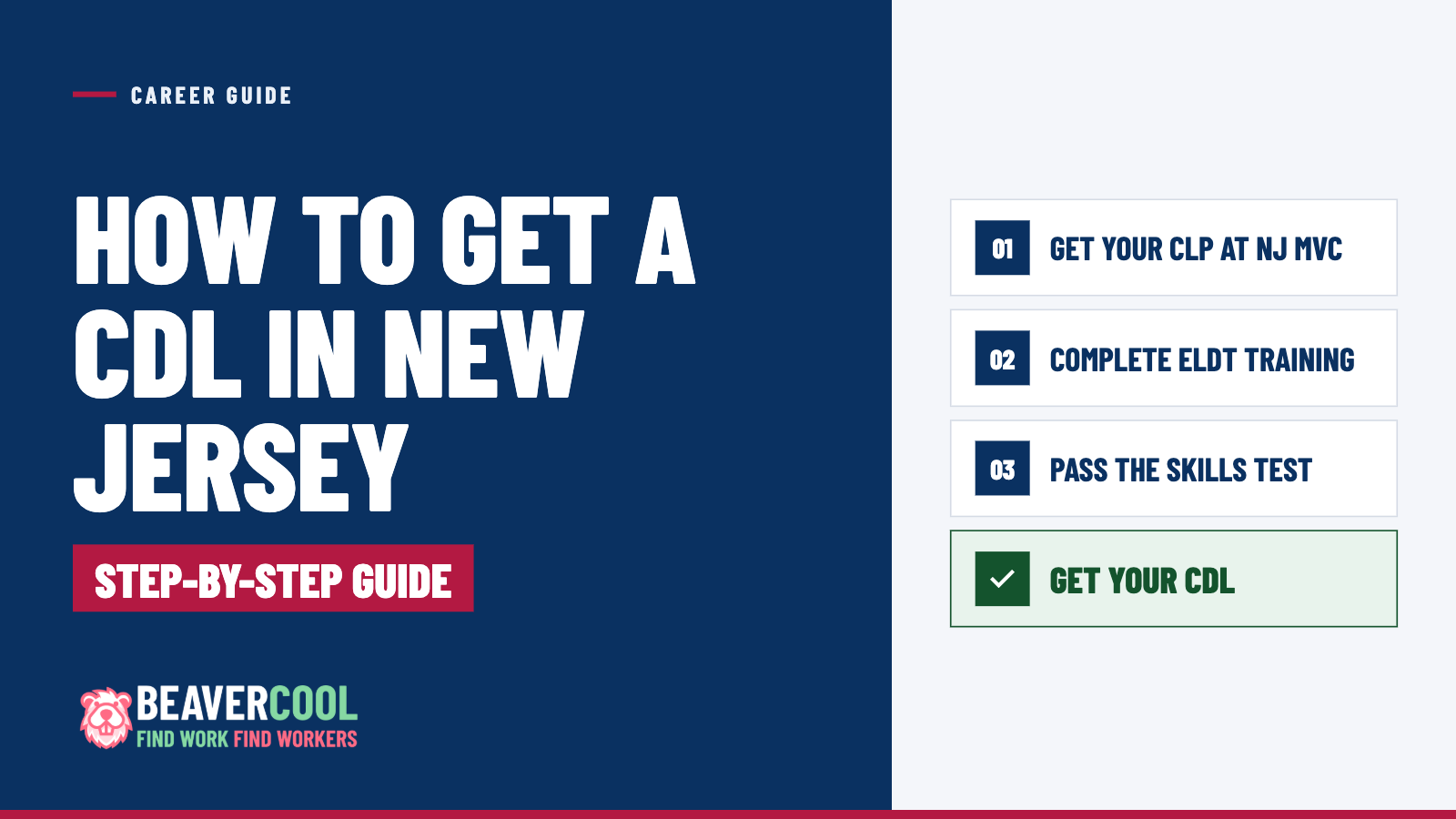
To get a commercial driver license (CDL) in New Jersey, you must hold a valid Class D basic driver license, meet the 6 Points of ID standard, submit an electronic medical certificate, obtain a Commercial Learner Permit (CLP), and pass the state skills exam. Drivers age 18 to 20 can earn an intrastate CDL to drive within New Jersey, while drivers 21 and older can qualify for an unrestricted interstate license.
Commercial driving offers steady work across local delivery routes, distribution facilities, and port terminals. This guide outlines the eligibility rules, paperwork standards, medical procedures, and testing steps set by the NJ MVC as of 2026.
Prerequisites to Get a Commercial Driver License in New Jersey
Before scheduling your commercial driving exams, you must meet state driver licensing and identity standards. New Jersey does not allow first-time drivers to apply for a commercial license without prior driving credentials.
You must hold an active New Jersey Class D basic driver license in good standing. If you recently moved from another state, transfer your out-of-state license to a New Jersey basic driver license before starting your commercial permit application.
Age Limits and Driving Restrictions
Your age dictates where you can legally operate commercial motor vehicles:
- Ages 18 to 20: You are restricted to intrastate commerce. You can only transport goods and passengers within New Jersey state borders. You cannot haul cargo that originated outside New Jersey or is bound for another state.
- Age 21 and older: You are eligible for interstate commerce. You can drive commercial trucks and haul freight across state lines throughout the United States.
Meeting the 6 Points of ID Standard
Every applicant must verify their identity, legal presence, and New Jersey residency at an NJ MVC licensing center using paper or hard-copy documents. The state does not accept digital documents or phone photos under the NJ MVC 6 Points of ID rules.
Complete Form BA-208 (Driver License Application) and bring original or certified documents totaling at least 6 points:
- At least one primary document: Examples include an official U.S. birth certificate, valid U.S. passport, or permanent resident card.
- At least one secondary document: Examples include a valid New Jersey Class D license, a school ID with transcript, or a bank statement.
- Proof of residential address: A utility bill, credit card bill, or lease agreement showing your name and New Jersey address.
- Social Security verification: Your physical Social Security card, official ITIN letter, or an authorized Social Security Administration affidavit.
Pay close attention to birth certificate rules. The NJ MVC does not accept Puerto Rico birth certificates issued prior to July 1, 2010. If you were born in Puerto Rico, you must provide a certified copy issued on or after that date. In addition, if you were born in Jersey City or Hudson County prior to 1965, you must obtain a newly certified copy or an official letter of authenticity from the Office of Vital Statistics.
Choosing the Right CDL Class and Endorsements
Commercial motor vehicles are divided into three classes based on weight, configuration, and cargo. Review our Class A vs Class B CDL guide to determine which class fits your career plans.
- Class A CDL: Required for any vehicle combination with a gross combination weight rating (GCWR) or gross combination weight of 26,001 pounds or more, whichever is greater, inclusive of a towed unit with a gross vehicle weight rating (GVWR) or gross vehicle weight greater than 10,000 pounds. This class includes tractor-trailers, livestock haulers, and flatbeds.
- Class B CDL: Required for single vehicles with a GVWR, registered weight, gross vehicle weight (GVW), or displayed GVWR of 26,001 pounds or more, whichever is greater. This class includes dump trucks, large box trucks, city buses, and cement mixers.
- Class C CDL: Covers vehicles that do not meet Class A or Class B standards but are placarded to transport hazardous materials or designed to carry 16 or more passengers including the driver. It also covers certain commercial vehicles for hire designed to carry 8 to 15 passengers including the driver, and specific school or camp transit vehicles.
You can also earn commercial endorsements to haul specialized loads or drive passenger vehicles. In New Jersey, any driver holding a passenger (P) or passenger/school bus (P/S) endorsement must keep an electronic medical certificate on file with the state, regardless of their selected commerce category.
Medical Certification and Self-Certification (CDSC-1)
Every commercial driver in New Jersey must officially declare how they operate by completing the CDL Holder Self-Certification form (CDSC-1). You must select one of four commerce categories:
- Category 1 (Non-Excepted Interstate): You operate across state lines and must meet federal medical standards.
- Category 2 (Excepted Interstate): You operate across state lines only for federally exempt tasks.
- Category 3 (Non-Excepted Intrastate): You operate only within New Jersey borders and must meet medical standards.
- Category 4 (Excepted Intrastate): You operate only within New Jersey for state-exempt purposes.
Drivers between the ages of 18 and 20 are legally restricted to Category 3 or Category 4. Selecting Category 1 or 2 while under 21 leads to application rejection.
The Electronic Medical Examiner Certificate Rule
To operate in non-excepted commerce, you must pass a physical examination administered by a medical professional listed on the Federal Motor Carrier Safety Administration (FMCSA) National Registry of Certified Medical Examiners.
According to the NJ MVC medical certification page, New Jersey does not accept physical paper medical certificates (Form MCSA-5876). Your certified medical examiner must transmit your exam results electronically directly to the FMCSA National Registry. The NJ MVC then retrieves your passing certification electronically.
Never allow your medical certification to lapse. If your electronic certificate expires or you fail to submit a signed CDSC-1 form, the NJ MVC decertifies your commercial driving privileges. The state will downgrade your CDL to a standard Class D license, making commercial driving illegal until you recertify.
Applying for Your Commercial Learner Permit (CLP)
Once your identity documents and medical filings are ready, you can apply for your Commercial Learner Permit (CLP).
Schedule an appointment at an NJ MVC licensing center. Bring your New Jersey Class D license, completed Form BA-208, 6 Points of ID, proof of address, and signed CDSC-1 self-certification form. An agency representative will review your documents and administer a vision screening.
Next, you will take the written commercial knowledge exams required for your vehicle class and endorsements on an agency computer. Because exam requirements depend on your intended license class, refer to the current NJ MVC commercial driver manual to review testing subjects, manual chapters, and passing scores.
After you pass the written tests, the agency issues your Commercial Learner Permit. The CLP allows you to practice commercial driving on public roads. While driving on a permit, you must be accompanied in the front seat by an active CDL holder who possesses the same license class and endorsements required for the vehicle.
Completing Training and Passing the NJ CDL Skills Test
With your permit in hand, focus on building practical behind-the-wheel experience to prepare for the commercial road test. Many applicants complete training through commercial driving schools, community colleges, or employer-sponsored programs.
Once you have practiced and feel confident, schedule your road test appointment at an NJ MVC skills testing facility. You must bring a commercial vehicle in the class you plan to operate, along with your supervising licensed driver.
The New Jersey CDL skills exam includes three primary sections:
- Pre-Trip Vehicle Inspection: You must walk around your vehicle and demonstrate to the examiner that it is mechanically safe. You will inspect components including tires, lights, fluid levels, coupling devices, and vehicle controls.
- Basic Vehicle Control Maneuvers: You must demonstrate control and spatial awareness by performing maneuvers inside a marked test area. Review the NJ MVC commercial driver manual for the specific maneuvering exercises tested during this portion.
- On-Road Driving Test: You will drive the vehicle on public roads with an examiner. You will be evaluated on practical driving skills, including turns, intersections, lane position, speed regulation, and safe stopping.
Receiving and Maintaining Your New Jersey CDL
When you pass all three portions of the skills test, the examiner validates your test documentation. Take your test results and learner permit to an NJ MVC licensing center to have your official Commercial Driver License issued.
To protect your commercial driving privileges over the long term, remember these critical maintenance rules:
- In-Person Renewals Only: Federal rules strictly prohibit renewing a commercial driver license by mail or online. You must visit an NJ MVC agency in person whenever your CDL is due for renewal.
- Continuous Medical Filings: Complete your physical exam and ensure your examiner submits the results before your current electronic medical certificate expires. Missing your renewal deadline triggers an automatic license downgrade to a Class D basic driver license.
- Driving Record Compliance: Commercial drivers face strict penalties for traffic violations, even when operating personal vehicles. Maintain a clean driving history to protect your employment eligibility.
Starting Your Driving Career in New Jersey
New Jersey is an essential hub for commercial freight and regional distribution. Commercial drivers transport goods out of Port Newark and Port Elizabeth, run regional delivery routes along the New Jersey Turnpike corridor, and move freight across Interstate 80 and Interstate 78.
If you are a newly licensed driver entering the market, read our guide on truck driving jobs with no experience to explore carriers that hire recent graduates.
If you are still working on your permit, taking on warehouse and logistics jobs in NJ is a great way to gain supply chain experience while finishing your credentials. Once your commercial license is in hand, browse current New Jersey transportation jobs to connect with local fleets and transport employers hiring across the state.
If you are a New Jersey employer looking to hire licensed commercial drivers, post your job on BeaverCool today or try our free Post for me service at /post-for-me to have our team handle the posting for you.